
Budapest’s Art Nouveau scene is more than pretty facades, and this private 4-hour walk shows how the Secession style actually worked in everyday buildings. You get both the exteriors and quick interior looks, not just street-level photos.
I especially like the professional art historian guide who turns architecture into clear stories, from Hungarian National Style to the switch toward Art Deco. The complimentary coffee or tea in an Art Nouveau café gives you a real moment to slow down and notice the details.
One thing to consider is pacing. The tour runs in about 4 hours with several short stops, so expect some walking and standing between sights.
Key highlights in plain sight
- Hotel pickup and drop-off from your hotel or port so you can start without fuss
- Parisian Passage Café coffee break inside a recently renovated Art Nouveau setting
- Liszt Academy interior focus with time for hall details and mosaics
- Váci Street palaces on foot for a shopping street that doubles as a design gallery
- Architect names in context including Miks a Roth and Lechner, tied to the style shift
- Museum of Applied Arts facade only because the building is still under renovation
Why Budapest’s Secession feels personal, not decorative
Budapest did not treat Art Nouveau as just a design trend. In this city, it became a language, especially through what is often called the Secession movement and the Hungarian National Style. That matters because you do not just learn what things look like. You learn why they were made the way they were, and what Hungarian identity looked like when architects had a new vocabulary.
On this tour, the design story is practical. You see the style move from one building to the next, and you watch it change as well. One of the most useful moments is the way the route points out the transition between Art Nouveau and Art Deco, instead of treating Secession as one fixed look.
If you are the kind of traveler who likes to connect the dots, this is a good fit. You will leave with a mental map for what to spot next time you walk through Budapest.
More Art Nouveau walks in Budapest:
- Art Nouveau Tour in Budapest: 3-Hour Private Tour
★ 4.6 · 21 reviews - Art Nouveau Treasures of Budapest – Exclusive Private Tour
★ 5.0 · 18 reviews - Budapest Art Nouveau Walking Tour
★ 5.0 · 17 reviews
Price and value for a private group up to 15
This tour costs $243.53 per group for up to 15 people, for about 4 hours. That pricing is interesting because you are not paying per person for the guide time. A group price like this can work especially well if you have a small crew, like a couple plus friends, or a family grouping that wants a single shared plan.
What you get for that price is not just narration from outside. You get a professional art historian guide, hotel or port pickup and drop-off, and a coffee and/or tea stop. Also, the scheduled stops list free admission for the entry points and views included on the route.
The only caution on value is realistic expectation: because it is private and timed, it cannot turn into an all-day museum binge. Think of it as architecture focused, curated for seeing several landmarks without losing the through-line.
Getting picked up, using the mobile ticket, and handling the 4-hour flow
The logistics are built for convenience. The operator offers hotel and port pickup and drop-off, and pickup is arranged for the ports or hotels you specify. You also get a mobile ticket, which keeps things simple at check-in.
The tour runs in all weather, so you should dress for rain, wind, or heat. The dress code is smart casual, nothing fussy, but you will want shoes that handle uneven pavement and time spent waiting at entrances.
Because the tour is private, only your group participates. You also have some flexibility in real life because a strong guide can adjust pace, and there is evidence that the guide approach can accommodate walking limits by using taxis and public transportation when needed. If you need that kind of adjustment, ask early so the route can be timed properly.
Parisian Passage Café: your first Art Nouveau interior look
The tour starts with one of Budapest’s most iconic passage settings, the Parisian Passage Café. This building is recently renovated, and the tour time is built around seeing both the lush exterior and the interior passage space.
You spend about 30 minutes here, and the admission for this stop is listed as free. You also get the complimentary coffee or tea in an Art Nouveau setting, which makes this the best “slow down” part of the tour. It is not just a break. It is a chance to look closely at how design works when you are seated, not just standing at a curb.
What to do with your guide here: ask what makes the passage feel different from a normal café. A guide can point out how the building uses light, glass, and architectural rhythm to turn a walkway into a destination. Even if you are not an architecture nerd, you will notice the difference once someone points out the details at eye level.
Practical tip: since this is an interior moment, keep your camera ready, but do not block entrances while you take photos. Your guide will set the pace.
A different sort of Budapest afternoon:
- Budapest: City Highlights Sightseeing Cruise
★ 4.6 · 43,981 reviews - Budapest: Unlimited Prosecco, Beer and Aperol Spritz Cruise
★ 4.8 · 37,304 reviews - Budapest: Széchenyi Spa Day Ticket with Optional Upgrades
★ 4.3 · 23,911 reviews - Budapest: Nighttime or Daytime Sightseeing Cruise
★ 4.2 · 21,062 reviews
Liszt Academy: Hungarian music meets international Secession design
Next up is the Liszt Academy, a building that connects the story of architecture to Hungarian music. It is also described as an homage to Hungarian music, while still being a grand example of the international secession style at the same time.
You get about 15 minutes at this stop, with free admission. The main payoff is the interior hall, including mosaics and other details that are meant to be seen with someone who can translate them into a bigger story.
Because your time here is shorter than the café stop, prioritize what you want to see. If you love ornament, focus on surface details. If you care more about composition, ask how the hall’s design supports sound and space. A good guide can make both topics feel connected without turning it into a lecture marathon.
Váci Street: finding Art Nouveau details while you shop
Then you move onto Váci Street, Budapest’s famous historic fashion and shopping street. The tour uses the street as a walking “gallery,” stopping at various urban palaces to explain the Art Nouveau heritage in the streetscape.
This part runs about 30 minutes, and the entry noted for these stops is free. Here is the key value: you get architecture teaching you how to look, while the city around you does what it always does. Even if you are not shopping, you are not bored, because the buildings are the focus.
A simple way to get the most out of Váci Street: split your attention in two. First look for repeating motifs on neighboring facades. Second, look for the differences your guide points out. That contrast is where you learn how style spreads and then localizes.
If you want photos, take them in short bursts. You will cover more by staying with the guide’s timing than by trying to stop every 20 feet on your own.
Török-Bankház to Postatakarék: where style shifts get explained
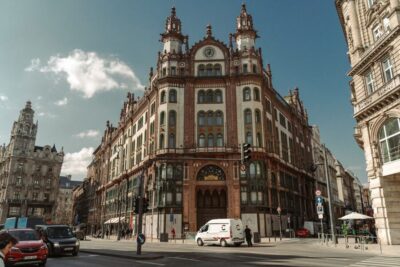
Two of the most design-forward stops come next: Török-Bankház and Postatakarék Bank. This is where the tour gets very useful if you like seeing change over time, not just collecting pretty buildings.
At Török-Bankház, the tour frames the building as a way to understand the transition between Art Nouveau and Art Deco, and it explicitly credits Miks a Roth. Your time here is about 15 minutes, and admission is listed as free.
Right after that, you go to Postatakarék Bank, associated with the Secession’s Hungarian National branch and Lechner. This stop is also about 15 minutes with free admission, and it is described as having marvellous architecture and enchanted castle-like details.
Why these two stops work together: you can see the logic of the change. Instead of guessing whether a building is “old style” or “new style,” your guide helps you connect the design choices to the broader pre-war shift.
Practical note: these stops are short, so be ready to look quickly. Bring your curiosity. Ask one smart question, like what signals the shift from one language of design to another, and then let your guide point out the answers on the facade.
House of Hungarian Art Nouveau and the Zoo sidestop
After the bank stops, you head to the House of Hungarian Art Nouveau. This is dedicated to the period of Secession in Hungarian architecture, and it is used on the tour to explain the Hungarian National Style and the influences behind it. You get about 15 minutes and free admission.
This stop is a useful “bridge” because it pulls the style back into Hungarian context. The tour’s earlier moments set up international influences and transitions. Here, you get the sense of a distinct local identity taking shape.
Then the route includes a sidestop that is a little different: you will see some of the buildings of the Budapest Zoo. This is described as a journey through the diversity of Art Nouveau and Secession architecture. The time mentioned for this segment is not specified separately, but it functions as a change of pace while still staying on theme.
If you like when a tour keeps variety without going off-topic, this kind of side look helps. It also reminds you that the style is not locked behind museum doors.
Museum of Applied Arts facade: what you can see during renovation
The route ends with a stop at the Museum of Applied Arts. This site carries trademarks of the Hungarian National Style of Secession, and you discuss and discover those design cues at the building.
Here is the expectation to set upfront: the museum is still under renovation, so you can only explore the facade, not the full interior. Time on this stop is about 15 minutes, with free admission as listed.
This is still worthwhile if you treat facades like architecture you can read. Ask your guide what to look for in terms of Secession identity. A facade stop can be more powerful than it sounds when someone guides your eyes to the specific elements that indicate the style.
Practical tip: wear something with a hood or bring a light layer if it is rainy. You may be standing around looking up for a bit.
Coffee, interiors, and what makes the private guide feel special
The heart of the experience is the private guide, led by a professional art historian. The best part of a private tour is not speed. It is clarity, because you can ask questions that match your interests.
In past guide feedback tied to this experience, names like Szoke Zsuzsanna, Bogata, Michael, and Suzy show up for their enthusiasm and their ability to connect architectural details to Hungarian culture and history. You will feel the difference when the guide ties motifs on a facade to what they meant in daily life.
One of the smartest moments comes from the café stop. The complimentary coffee or tea is served in an Art Nouveau setting, with Art Nouveau tables and chairs you can actually sit at. That turns “learning” into a sensory experience, and it makes the design feel less theoretical.
Also, because it is private, there is room for the guide to adjust. There is an example of a guide adapting the tour for limited walking ability, including use of taxis and public transportation when needed. If mobility is a concern, tell the operator and ask the guide how the route can be tweaked.
If you are short on time in Budapest, this is a strong pick because it gives you guided interior glimpses and a themed walk in one half day. If you have more time, it still works as a primer so you can recognize Secession and Art Nouveau cues on your own after the tour ends.
Should you book this Budapest Art Nouveau tour?
Book it if you want a structured, design-focused half day with a private guide, plus a real break with complimentary coffee or tea in a historic Art Nouveau setting. It is also a good choice if you like the idea of seeing how Hungarian Secession fits into the broader European transition toward Art Deco.
I would skip it if you want a slower pace with long museum time, or if you dislike walking and standing around facades. Even with hotel pickup, the tour is still built around multiple stops that move you through the city.
One last practical check: decide if you want a guide to help you see details. If yes, this tour is built for that. If you mainly want to wander alone, you might prefer spending the same hours doing independent exploring with your own saved favorites.
FAQ
How long is the Private Art Nouveau Tour Budapest?
It runs for about 4 hours.
Is this tour private?
Yes. It is a private tour, and only your group participates.
What is the group size limit?
The tour price is per group up to 15 people.
What language is the tour offered in?
The tour is offered in English.
Do you offer hotel or port pickup and drop-off?
Yes. Pickup and drop-off are included, and you can specify the ports or hotels you want.
What is included in the price?
Included features are a professional art historian guide, hotel or port pickup and drop-off, the private tour format, and coffee and/or tea.
What is not included?
Public transportation tickets are not included.
Do I get a ticket on my phone?
Yes. You receive a mobile ticket.
When will I receive confirmation after booking?
Confirmation is received within 48 hours of booking, subject to availability.
What is the cancellation policy?
You can cancel for a full refund if you cancel at least 24 hours before the experience’s start time.
Newest reviews from Budapest
- Private Tour Around Budapest★ 5.0 · 10 reviews
- Born Under The Red Star – Communist tour with Coffee in a Retro Bar★ 5.0 · 10 reviews
- Live virtual walking tour in the Buda Castle quarter★ 5.0 · 10 reviews
- Taste Budapest – Fat Boy Foodies Walk★ 4.5 · 10 reviews
- Wine & Food Tasting Cruise on the Danube★ 3.5 · 10 reviews
- Private Transfer from Budapest to Prague with 2 hours for sightseeing★ 4.5 · 10 reviews
- The Real Saw | Escape Room by PÁNiQ SZOBA★ 4.1 · 10 reviews
- City Park True Crime of Hungary and Night Walk Tour in Budapest★ 5.0 · 10 reviews
Art Nouveau, compared.
Art Nouveau Tour in Budapest: 3-Hour Private Tour
Read our review →
Art Nouveau Treasures of Budapest – Exclusive Private Tour
Read our review →
Browse the lists this tour appears in