
Reviewed · BUDA CASTLE
Buda Castle Tour: History and Architecture
This tour is interesting because you do not just look at Buda Castle. You walk through the layers of power and faith that shaped Budapest, from royal courts to merchant streets to a surviving medieval prayer house. I like the way the guide turns architecture into a story, and I love the small group feel that keeps questions flowing.
One possible drawback: it is a moderate uphill walking route and it is not suitable for limited mobility. Also, you focus on exteriors and courtyards, not full interior visits of major landmarks.
Key highlights at a glance
- Royal Palace layers you can actually spot from Gothic to Baroque to Neoclassical influences
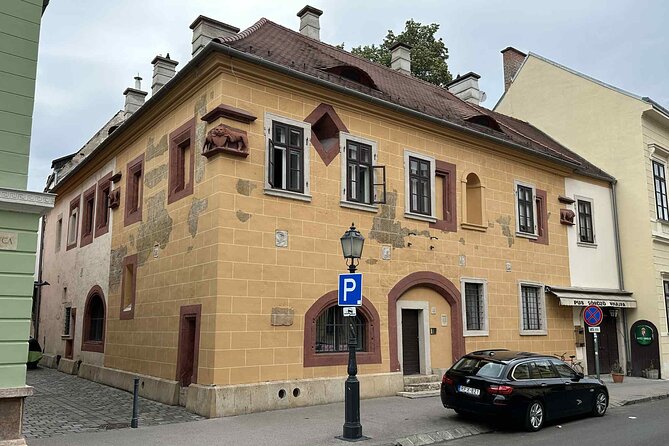
- Medieval street life below the palace on Tárnok Street and Úri Street
- A rare surviving Jewish prayer house in the medieval Jewish quarter (ticket included)
- Siege history along the outer walls tied to the 1686 battles for Buda
- Craft and art traces like a surviving 16th-century sgraffito on Országház Street
- A guide who uses visual reconstructions on a tablet, plus lots of historical and archaeological context
Why this Buda Castle walking tour feels different
The first thing you notice on a good Castle District walk is that everything looks connected. This route makes that connection plain. You start near Prince Eugene of Savoy, then end by Matthias Church, moving through palace courtyards, medieval commercial lanes, and the Jewish quarter, before finishing at Fisherman’s Bastion.
At a price of about $43.25 per person for roughly 3 hours and 30 minutes, it is not an all-day binge of monuments. It is a focused history and architecture walk that adds real meaning to what you see outside, and it includes one important paid entrance.
You also benefit from a tight group size. This experience caps at 12 travelers, which matters on Castle Hill. When you can hear the guide and keep up without sprinting, you get more out of the details.
More of the Castle District:
- Budapest: Buda Castle Cave Tour
★ 4.7 · 5,677 reviews - Budapest: Buda Castle District Vampires and Myths Night Tour
★ 4.6 · 3,830 reviews - Budapest: Buda Castle Walk with Saint Stephen’s Hall
★ 4.5 · 3,012 reviews
What you get for the price, and what you do not
Let’s talk value without sugarcoating it. Your ticket covers:
- an official English-speaking guide
- a guest pass with lanyard
- entrance to the medieval Jewish praying house, which is a standout stop on this route
You do not get:
- entry to the Royal Palace interior
- entry to Matthias Church interior
- entry to the upper panoramic terrace at Fisherman’s Bastion
That last point is especially important. Fisherman’s Bastion is famous for views from higher levels. This tour gives you the monument and central features from the main area, but not the ticketed terrace.
If you love architecture and want context, this format works well. If your top goal is interior rooms, you will still have to plan extra time after the tour.
Starting at Prince Eugene, ending near Matthias Church
The tour begins at the Statue of Prince Eugene of Savoy in Budapest. Getting there is usually straightforward because the area is close to public transportation. You end at Szentháromság Square, right by Matthias Church.
That finish point is a gift. It sets you up to keep exploring immediately, whether you want to enter Matthias Church on your own, grab a coffee nearby, or simply watch the Castle District shift into evening light. The walk is paced as a coherent route, not a stop-and-dash scramble.
Stop 1: Buda Castle Royal Palace, and the palace that keeps getting rebuilt
Your first big stop is Buda Castle, especially the Royal Palace as an architectural landmark. This is not treated as one finished building. It is explained as a site that got rebuilt again and again due to conflict, changing rulers, and evolving tastes.
That repeated rebuilding is what makes this area so fascinating to walk around. You start to see the idea that Hungary’s history is literally layered on the hill. In practical terms, the guide helps you notice those shifts, so you are not just looking at walls, you are learning to read them.
A good part of the experience here is the pacing. You get time to take in the landmark and understand it before you move into smaller, more intimate parts of Castle Hill.
More history walks in Budapest:
- Budapest: Historic Cruise with Welcome Drink
★ 4.7 · 6,512 reviews - Budapest Historical Sightseeing – Free Walking Tour
★ 5.0 · 1,302 reviews - Buda Castle District Dark History, Legends and Vampire Night Tour
★ 4.5 · 1,240 reviews - BloodThirsty Hungary: Walking tour & Dark Historical Stories
★ 4.9 · 633 reviews
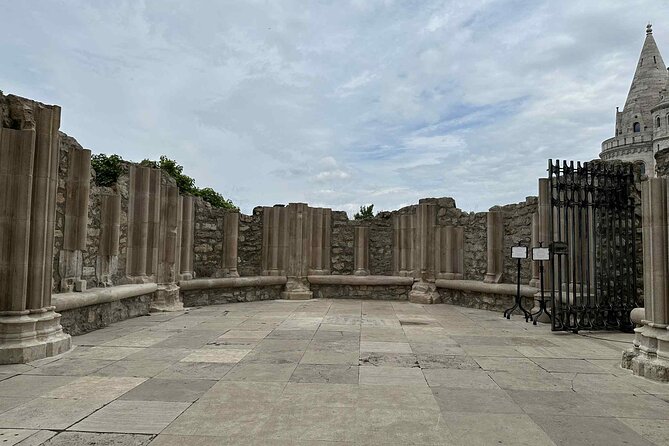
Stop 2: Sigismund Church remains, Gothic foundations in the courtyard
Next you move to the remains of the medieval Sigismund Church. The key detail is that you are seeing foundations rather than a fully standing church. During the palace expansion in the early 15th century under King Sigismund, a Gothic-style chapel became part of the palace complex.
Today, those foundations show up in the courtyards below. It is a short stop, but it is one of the most meaningful ones because it trains your eye to look for what is missing. You start to understand why archaeologically guided tours can feel more real than a postcard.
If you like history that is tangible, this is your moment.
Stops 3 and 4: Tárnok Street and Úri Street, where medieval Buda did daily business
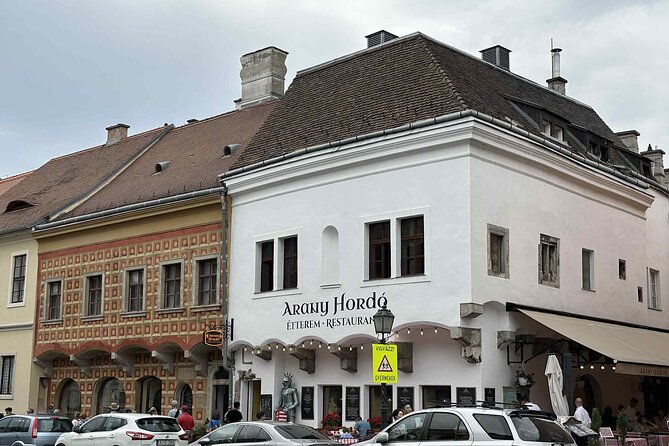
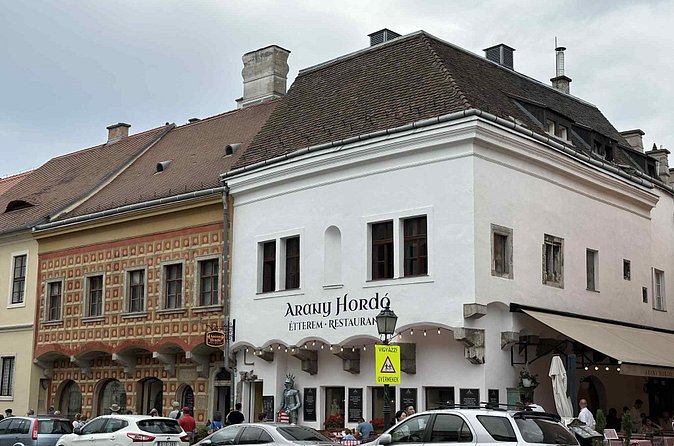
After the royal and religious stops, you shift to the human scale: Tárnok Street and Úri Street. These are the lanes that make the Castle District feel like a lived-in city, not a museum backdrop.
On Tárnok Street, you walk a cobbled commercial street from medieval Buda’s burgher town. The focus is on preserved merchant houses and what that meant for storage, trade, and everyday commerce. The guide points out how the buildings survived years of siege and fire, even while the city around them changed.
Then you continue to Úri Street, the former noble residential quarter. This part is about status and power expressed through architecture, plus the ornate medieval gateways that once welcomed craftsmen, merchants, and travelers. It is a great reminder that Buda’s elite was not isolated. The castle neighborhood still depended on movement, trade, and access.
If you only ever visit viewing platforms, you miss this layer. These streets are where the story gets practical.
Stop 5: Saint Mary Magdalene tower, a church story told through survival
The Church of Saint Mary Magdalene is one of those stops that hits emotionally, even if you are just outdoors looking at stones. The site connects to the earliest church on Castle Hill, with foundations dating back to the 13th century.
The tower you can see today carries a dramatic history. The structure was partially destroyed during the siege of Buda in 1686. Then in the 1950s, the communist regime ordered the demolition of the ruined church. The medieval tower survived, thanks to archaeological and preservation efforts.
So here the architecture lesson is also a memory lesson. You are looking at a single remaining vertical landmark that represents continuity through interruption.
Tip: if you are taking photos, this is a great place to pause long enough for the tower to frame with the surrounding stonework. The context matters.
Stop 6: Országház Street, the Italian Street and a surviving Renaissance trace
Next comes Országház Street, historically known as the Italian Street. The guide explains that Italian merchants helped shape Buda during the 14th and 15th centuries, and you get a sense of why trade and diplomacy pulled different cultures together on Castle Hill.
The standout detail is art surviving inside a medieval shell: the only surviving 16th-century sgraffito decoration in the entire Castle District. Sgraffito is the kind of delicate surface detail you would easily miss on your own.
This stop is worth it if you like small clues. The guide helps you see what to look for, which turns an ordinary wall into a history marker.
Stop 7: Neo-Gothic Ministry of Finance building, reconstruction with controversy
You then reach the Volt Magyar Királyi Pénzügyminisztérium building, now the Ministry of Finance. It is Neo-Gothic and originally built in the early 20th century, but the design required demolishing medieval structures to make way for it.
World War II damage followed, and then post-war years simplified the façade. In the past several years, reconstruction efforts brought back much of the original façade, restoring the look.
That said, it also sparked debate because part of an original wing was demolished during the process. The tour uses this stop to show how heritage is not always a clean story. Decisions made in one era can erase pieces of another.
It is a useful reality check in a place famous for surviving through time.
Stop 8: Matthias Church exterior, the official name matters
You will see Matthias Church as the famous landmark, but the tour keeps the terminology straight. Its official name is the Church of the Assumption of the Buda Castle, and the guide explains that it originally served Buda’s German-speaking community.
This matters because it reframes the church from a single national icon into part of a multi-ethnic religious history on Castle Hill. When you know that, the building starts to feel like it belongs to the full complexity of Budapest.
Interior entry is not part of this tour, so your experience is mainly viewing and context from outside.
Stop 9: Fortuna Street, printing history and the Red Hedgehog Inn
Fortuna Street is a quieter street today, but the story here is loud. In the 1470s, a German-born printer, Andreas Hess, produced Hungary’s first printed book here: the Chronica Hungarorum.
The tour also mentions the Red Hedgehog Inn (Vörös Sün), once a legendary meeting point for travelers, merchants, and intellectuals. Even if the street has changed, you still get the sense of how ideas traveled alongside goods.
This is a great stop for anyone who likes the intersection of culture and economics. Books were made possible by trade networks and urban life, not just by scholars in isolation.
Stop 10: Becsi Kapu Square, a medieval marketplace and gateway
At Becsi Kapu Square, you get the idea of the Castle District as a working city. Historically, it served as a marketplace and a main entrance to medieval Buda, bringing Hungarian townsfolk and members of the local Jewish community together for trade, talk, and worship.
Today it is charming and calm enough for a pause, but the guide frames it as social infrastructure. You are not just seeing a square. You are seeing how people met and exchanged both goods and news.
That social angle is what helps the whole tour stay grounded.
Stop 11: The National Archives building, why it looks older than it is
Next is the National Archives of Hungary, built in the early 20th century in a Neo-Romanesque style. The design is meant to echo the medieval character of the Castle District, so the building can look older than its actual age.
The tour makes the point that the archives are not just architecture. They symbolize national memory, housing documents across the scope of Hungary’s written past.
Even if you do not go inside, standing there gives you a sense of how modern institutions chose to visually link themselves to medieval foundations.
Stop 12: Siege of Buda memorial, outer walls and the 1686 turning point
Walking along the outer walls, the focus shifts to the Siege of Buda in 1686. At the Arnavut Abdurrahman Abdi Paşa memorial area, you learn where walls were first breached by allied forces and where the Ottoman Pasha of Buda fell in battle.
This stop is a change of pace from streets and buildings. It is more about geography and cause-and-effect. You start to understand why the Castle Hill layout mattered so much in warfare.
It also helps you connect the palace narrative to the city’s survival story.
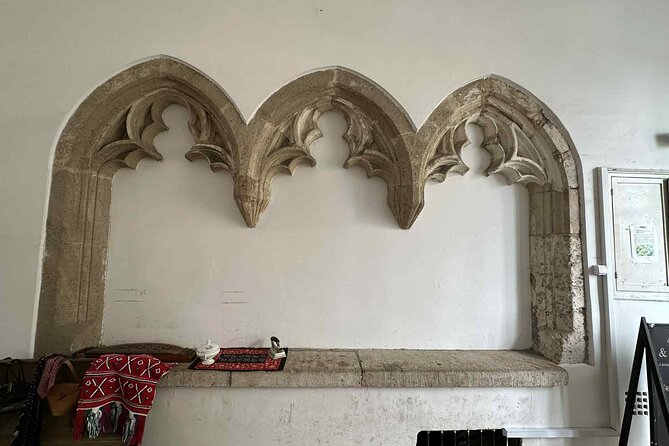
Stop 13: Medieval Jewish Chapel and prayer house, quiet, serious, and ticketed
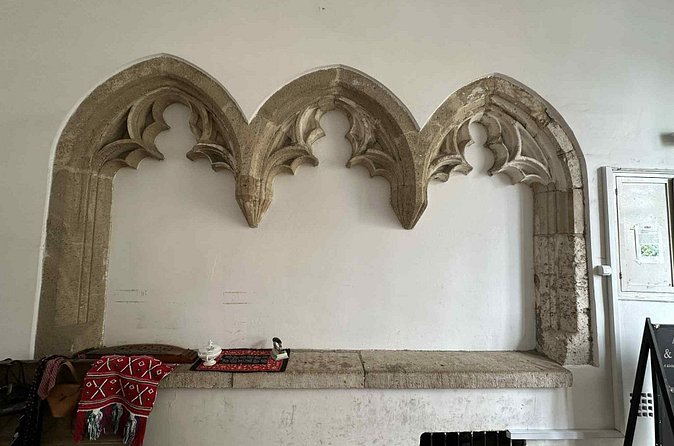
The tour then enters the medieval Jewish quarter area for the Mediaeval Jewish Chapel stop. This includes the site of a former Gothic synagogue and the chance to step inside the excavated medieval Jewish prayer house.
This is one of the most important included stops. The tour describes it as one of the rare surviving examples of Jewish religious architecture from the Middle Ages in Hungary. The prayer house is modest in size but heavy in meaning, because it shows everyday faith and resilience inside Castle Hill walls.
One practical note: the entrance is included, but the prayer house is closed on Saturday and Monday. If your travel dates fall on those days, plan to adjust your expectations.
Stop 14: Táncsics Mihály Street, medieval ruins reused into later buildings
Next you walk along Táncsics Mihály utca, where the tour points out reused medieval walls and cellars from the 17th and 18th centuries.
Instead of demolition, you see incorporation into later Baroque and residential buildings. That layering gives you a physical example of how a city rebuilds after major disruption, including after Ottoman times.
Even with short time here, you can usually spot how the lines of a later façade sit on earlier bones. It is a smart stop if you like spotting construction logic.
Stop 15: Dominikánus Udvar, Dominican monastery ruins and the Hilton-era twist
At Dominikánus Udvar, you see remains linked to the Dominican monastery of Saint Nicholas. The tour connects this place to Friar Julianus, who made a legendary journey in the 13th century.
Then the story gets modern and a bit controversial. The ruins endured fire, siege, and neglect, but were reinterpreted during Hilton Hotel construction in the 20th century. The result is a blend of medieval stonework and modern hotel architecture.
This stop is not about perfect preservation. It is about how cities keep using old material, sometimes in ways that make people argue.
It is also a good lesson for how Budapest manages tourism, development, and heritage all at once.
Stop 16: Fisherman’s Bastion, the King Stephen statue view, and what you miss upstairs
The tour finishes at Fisherman’s Bastion, one of Budapest’s most iconic spots. At its center is the equestrian statue of King Saint Stephen, Hungary’s first Christian king, used as a symbol of the birth of the Hungarian state.
You will admire the monument from the main level. You will not enter the upper panoramic terrace, since access needs a separate ticket and is not included in your tour price.
If views are your top priority, you might want to buy that ticket afterward. If your priority is context and walking history, you get a satisfying finale without paying extra on the spot.
The guide makes the difference, and Máté is the kind you remember
The strongest praise tied to this tour is the guide. The experience is run by Máté, described as not just friendly but also deeply passionate about history and architecture, with an archaeological angle.
What stands out is the teaching style. He links what you see to what it likely looked like in earlier centuries, and he often uses photos and reconstructions on an iPad to make the changes more understandable.
That matters because Castle Hill can be confusing. From street level, buildings overlap and rebuild, and it is easy to feel like you are just walking from one landmark to another. Máté keeps it ordered, so each stop answers a question like how did the city function, and how did it change?
He also handles questions well. On a short, high-information tour, that responsiveness makes the experience feel less like a lecture and more like a guided walk with real back-and-forth.
What to wear and how to pace yourself on Castle Hill
This is a walk with steady movement. You should plan on moderate fitness and expect uneven stones and stairs in parts of the Castle District.
If you get cold easily, keep in mind that December and spring can feel sharp on the hill. Even with good guidance, you are outdoors most of the time, so bring layers and shoes that grip.
You also want to arrive with a calm mindset. The tour runs about 3.5 hours, so do not schedule something rushed right before it.
Who should book this tour
This is a great fit if you:
- care about architecture you can read rather than just take photos of
- want a structured route that connects palace power to everyday medieval street life
- like guided storytelling, especially with archaeological context
- prefer a small group walk over a large bus-style sightseeing day
You might choose a different option if you:
- mainly want to go inside major interiors like the Royal Palace or Matthias Church
- need a fully accessible route, since the tour is not suitable for limited mobility
- are traveling with a child under 10, since children under 10 are not permitted
Should you book? My straight answer
If your idea of a perfect Budapest day is walking, looking closely, and learning how the city got its layers, then this is a strong value buy for $43.25. The included Jewish prayer house entrance adds weight, and the guide’s archaeology and architecture focus makes the route feel more than just a list of famous stops.
If you want mostly interiors and ticketed panoramic terraces, treat this as the history spine of your day, then add extra entries on your own afterward.
Either way, it is an excellent way to see the Castle District as a real city shaped by rebuilding, trade, and faith, not just as a backdrop.
FAQ
What is the meeting point and where does the tour end?
The tour starts at the Statue of Prince Eugene of Savoy in Budapest and ends at Szentháromság Square next to Matthias Church.
How long is the tour, and how big is the group?
The tour lasts about 3 hours and 30 minutes and is limited to a maximum of 12 travelers.
What entrance fees are included in the tour price?
The tour includes the entrance fee to the Jewish Praying House (the medieval Jewish prayer house). It is closed on Saturday and Monday.
Are Royal Palace interiors included?
No. Admission to the interior of the Royal Palace is not included, and you can visit independently after the tour ends.
Is Matthias Church interior included?
No. Admission to the interior of Matthias Church is not included.
Is the upper terrace at Fisherman’s Bastion included?
No. Access to the upper panoramic terrace at Fisherman’s Bastion is not included in the tour price. You can purchase tickets on-site if you want to go up.
Newest reviews from Budapest
- Private Tour Around Budapest★ 5.0 · 10 reviews
- Born Under The Red Star – Communist tour with Coffee in a Retro Bar★ 5.0 · 10 reviews
- Live virtual walking tour in the Buda Castle quarter★ 5.0 · 10 reviews
- Taste Budapest – Fat Boy Foodies Walk★ 4.5 · 10 reviews
- Wine & Food Tasting Cruise on the Danube★ 3.5 · 10 reviews
- Private Transfer from Budapest to Prague with 2 hours for sightseeing★ 4.5 · 10 reviews
- The Real Saw | Escape Room by PÁNiQ SZOBA★ 4.1 · 10 reviews
- City Park True Crime of Hungary and Night Walk Tour in Budapest★ 5.0 · 10 reviews
Buda Castle, compared.
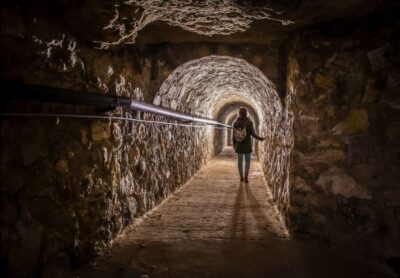
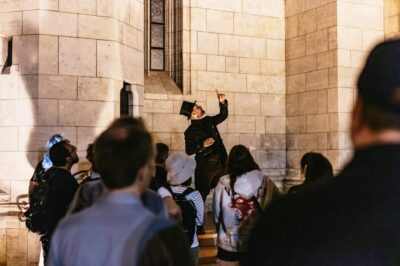
Buda Castle District Vampires and Myths Night Tour
Read our review →
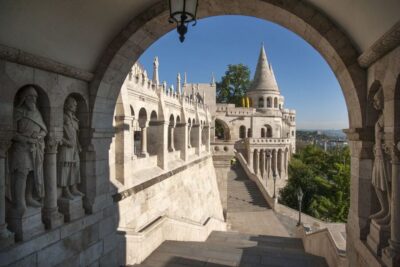
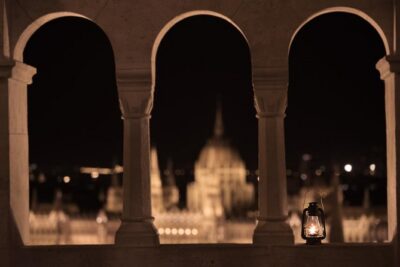
Buda Castle District Dark History, Legends and Vampire Night Tour
Read our review →
Buda Castle District Walking Tour with a Historian
Read our review →
Walking tour in the Buda Castle incl. Fisherman’s Bastion
Read our review →Browse the lists this tour appears in